The greenest neighbourhoods in London, ranked by satellite data
Where London is actually green, neighbourhood by neighbourhood, using satellite data instead of borough averages.
What the data shows
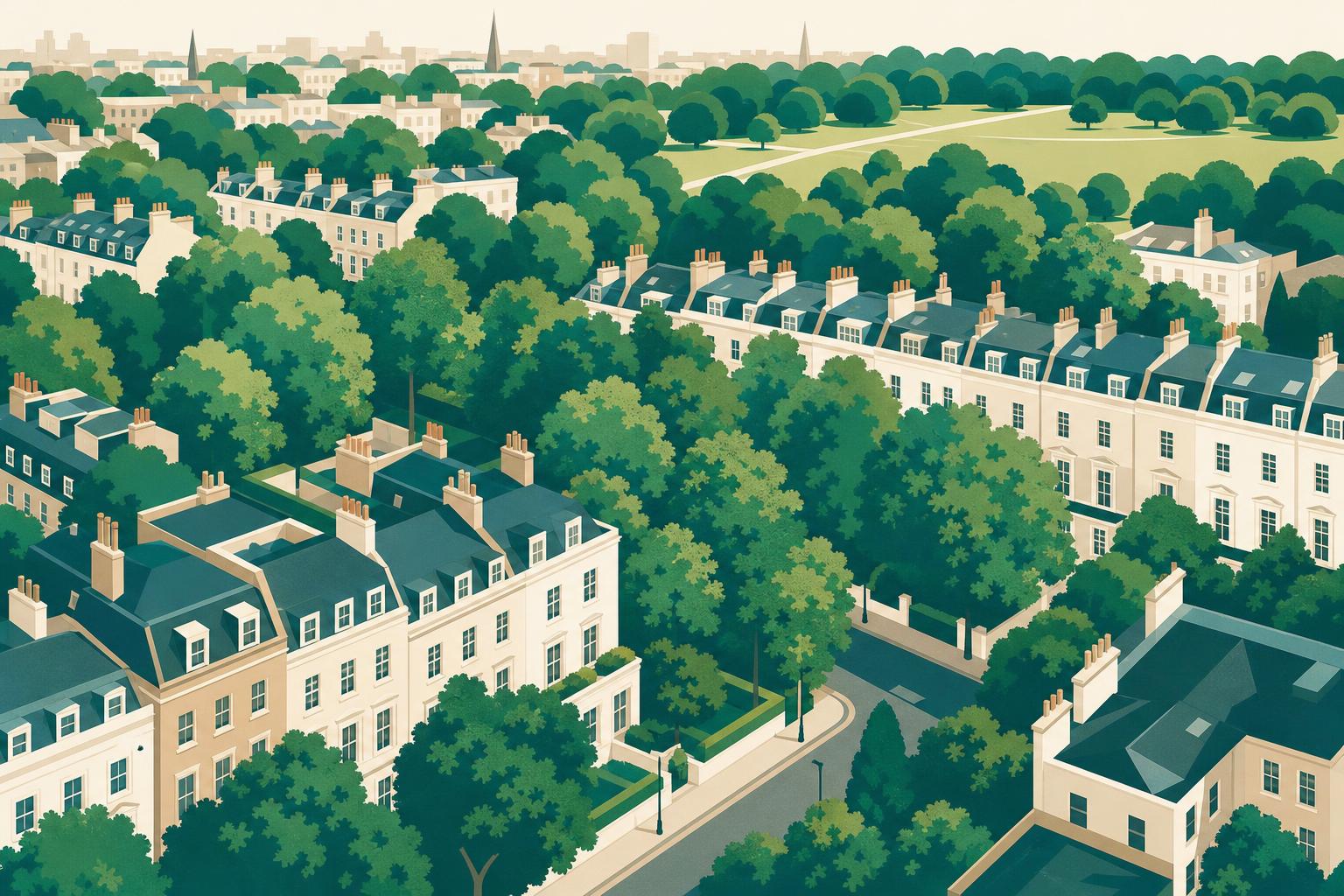
If you want to live somewhere genuinely green in London, ignore borough rankings. They average out huge areas and hide the street you would actually live on. HoodEx scores individual neighbourhoods using satellite imagery, and the results diverge sharply from the official lists.
In July 2026, we analysed 40 London neighbourhoods across five pillars. This article digs into the green space scores — and the trade-offs that come with them.
The leafiest pockets are in Hampstead, Highgate, Richmond, Petersham, Belsize Park, Kingston and Greenwich. But here is the surprise: greenery barely correlates with property price. If trees are your priority, you do not automatically need a Hampstead budget.
Why borough-level green statistics mislead
Most "greenest London" rankings use borough boundaries because councils publish open-space data that way. But boroughs are administrative conveniences, not places people live.
Havering and Bromley often top borough tables because they contain outer-edge farmland and golf courses — greenery most residents never touch. Meanwhile, a genuinely leafy pocket inside a dense inner borough vanishes into the average.
Estate-agent lists have the opposite problem: they are marketing. When the company selling homes in those neighbourhoods also writes the ranking, treat the ordering with caution.
Neighbourhood-level scoring fixes both. Across the 40 neighbourhoods analysed, green space moves in the opposite direction to food, entertainment and busy streets. The dataset shows a strong inverse correlation between green space and food services. The leafiest streets and the liveliest streets are usually different streets, even within the same borough. A borough average blends them into a number that describes neither.
−0.812 — inverse correlation (Between green space and food services across 40 neighbourhoods)
How satellite scoring works
HoodEx scores neighbourhoods using AI analysis of satellite imagery combined with mapped urban data, applied the same way in every city we cover. For the green space and environment pillar, the score reflects what is physically on the ground — tree canopy, parks, commons, gardens and open land within the neighbourhood itself.
Every neighbourhood is assessed on the same 0–10 scale, which makes scores comparable across London and against neighbourhoods in Amsterdam, Paris, New York and elsewhere on the HoodEx leaderboard.
The London scores quoted here were generated on 24 July 2026, from the report published on 29 July 2026. Live scores may drift slightly as fresh imagery is analysed.

The green heavyweights
The July 2026 data flags the following neighbourhoods as London's green standouts. We have listed their verified overall HoodEx scores and who each one suits.
Hampstead — overall score 8.42/10
Hampstead is the top-scoring neighbourhood in the entire 40-neighbourhood London analysis, and greenery is a big part of why. The neighbourhood sits directly on Hampstead Heath — 320 hectares of woods, meadows and swimming ponds that read as unbroken green from orbit. The satellite view is not "a park nearby"; it is a village grafted onto the edge of a small wilderness.
Who it suits: people who want serious nature — proper walks, wild swimming, actual hills — without leaving Zone 2. The trade-off is price and a quieter evening scene than central London.
Highgate
The report is blunt: "For greenery and calm, Highgate and Hampstead lead." It also notes that "Step out in Highgate and the city can feel leafy and hushed." Between Highgate Wood, Queen's Wood, Waterlow Park and the Heath's eastern fringes, Highgate is one of the few parts of inner London where ancient woodland defines the neighbourhood rather than decorating it.
Who it suits: buyers and renters who want Hampstead-grade greenery with a slightly more village-like, lived-in feel. Nightlife seekers should look elsewhere — green space and busy streets rarely coexist.
Richmond upon Thames — overall score 8.24/10
Third overall in the London analysis. Richmond pairs the Thames towpath with Richmond Park, the largest of London's Royal Parks, plus Kew Gardens a short hop away. Few places in any European capital put this much protected green land within walking distance of a town centre.
Who it suits: families, runners, cyclists and anyone whose ideal weekend involves deer, river and no Tube required — though the District line and rail links into Waterloo keep the city reachable.
Petersham — overall score 8.4/10 (live leaderboard)
A small riverside village tucked between Richmond Park and the Thames, Petersham currently posts one of London's highest scores on the live HoodEx leaderboard. From above, it barely reads as city at all: water meadows on one side, the park wall on the other.
Who it suits: people who want the greenest possible setting that still technically counts as Greater London, and who are happy trading transport convenience for it.
Belsize Park — overall score 8.5/10 (live leaderboard)
Currently London's highest-scoring neighbourhood on the live leaderboard. Belsize Park borders Hampstead Heath to the north while keeping a proper high street of its own — one of the rare spots where the usual green-versus-buzz trade-off softens.
Who it suits: those who want Heath access plus cafés, a cinema and the Northern line on the doorstep. Expect NW3 prices.
Kingston upon Thames — overall score 8.22/10
Fifth overall in the July 2026 analysis. Kingston combines a long stretch of Thames riverside with quick access to Richmond Park's Kingston Gate and Home Park by Hampton Court. Nearby Surbiton, its riverside neighbour, scores 8.3/10 on the live leaderboard.
Who it suits: people priced out of Richmond who still want river, park and a full-sized town centre — a practical green option rather than a postcard one.
Greenwich — overall score 8.07/10
The only neighbourhood in the top ten south of the river and east of centre. Greenwich Park's 74 hectares climb from the Thames to the Royal Observatory, and Blackheath's open common sits directly behind it.
Who it suits: East and South-East Londoners who want real green space without moving to the other side of the city — and anyone who values a park with a view over a park with a fence.

What green space buys you — and what it doesn't
Two findings from the report are worth knowing before you choose.
First, green space predicts how well a neighbourhood works overall. Across the 40 neighbourhoods, the green space score correlates positively with the overall score (r = +0.450, p = 0.004) and strongly with the report's harmony measure (r = +0.725, p < 0.001). Greener neighbourhoods are not just prettier; in this dataset they tend to be more coherent, better-balanced places all round.
Second, green space is not priced in. The correlation between green space and property price across the dataset is essentially zero (r = −0.085, p = 0.601). London prices track prestige, centrality and transport far more than they track greenery — which means genuinely green neighbourhoods exist at many price points. If green space is your priority, the data says you do not automatically have to pay Hampstead money for it.
And the trade-off is real. That inverse correlation between green space and food services means the leafiest neighbourhoods rarely have the busiest restaurant scenes. The report's advice for nightlife seekers — start with Covent Garden and Soho "and accept that the park may not be outside your door" — cuts both ways. Decide which side of that trade you are on before you decide where to live.
Rule of thumb: Decide which side of that trade you are on before you decide where to live.

Explore the live scores
Rankings age; satellite data gets refreshed. To see how every London neighbourhood scores right now — on green space and the other four pillars — explore the full London 2026 report, browse individual neighbourhood scores, or see how London's greenest stack up against the rest of the world on the global leaderboard.
HoodEx scores every neighbourhood on nature, people, buildings, society and connections. The greenery is visible from space. Now the scores are too.
Related posts
- Why real-time sentiment beats static neighborhood data
- How to evaluate safety and walkability before moving
- Walk Score vs AreaVibes vs Hoodex: what neighborhood scores measure (and miss)
More from the HoodEx blog · City studies · Explore neighborhoods