How to choose a neighbourhood in a new city
The pillar that decides it changes from city to city

Everyone arrives in a new city with the same checklist. Safe, green, good transport, decent cafés, not too expensive. It is a fine list, and it is the reason so many people end up in the wrong place: the list treats all five things as equally decisive everywhere, and they never are.
In one city, the difference between a good year and a bad one is a tram stop. In another, it is whether the street has trees on it. In a third, none of that matters much and what decides it is who your neighbours turn out to be. The categories stay the same from city to city. Their weight does not.
This is a guide to finding the one that decides it where you are going — before you sign anything.
The five things a neighbourhood can be good at
HoodEx scores every neighbourhood from 0 to 10 across five dimensions borrowed from Ekistics, the study of human settlements. They are a useful vocabulary even if you never open the app:
- Nature — green space, parks, air quality, climate, environmental quality.
- Anthropos — the individual resident: everyday safety, health, comfort, the texture of an ordinary day.
- Shells — buildings and housing: construction quality, density, architectural character.
- Society — community life: culture, local services, amenities, social fabric.
- Networks — connectivity: public transit, walkability, roads, digital access.
A neighbourhood scoring 7.4 overall tells you almost nothing on its own. The same 7.4 can be a quiet, leafy, badly connected suburb or a loud, grey, superbly connected inner district. What you actually need to know is which of the five you cannot afford to get wrong in this particular city.
5 — pillars, one overall score (the average hides which pillar carried it)
Why the deciding pillar moves between cities
A pillar becomes decisive when the city makes it scarce, expensive to fix, or impossible to opt out of. That is the whole rule. Everything below is that rule applied.

Compact, transit-rich cities: Networks decides
Vienna, Prague, Lisbon, Athens, most of Berlin. These cities are dense enough that almost every neighbourhood has bakeries, a park within reach and someone selling coffee. Society and Nature are broadly available, so they stop being differentiators. What varies brutally is how well the place is stitched into the rest of the city.
Two flats at the same rent, fifteen minutes apart on the map, can differ by forty minutes of daily travel because one sits on a radial line and the other needs an interchange. That difference does not fade. It decides whether you see friends on a Tuesday, whether you take the job across town, whether the city stays a place you explore or shrinks to the four streets around you.
What to check: not distance to the nearest stop, but where the lines from that stop actually go, how late they run, and how the trip looks in the rain at 23:00 rather than on a sunny Saturday.

Old, protected housing stock: Shells decides
Amsterdam, Edinburgh, Porto, large parts of Italy. The photographs are the reason people move there, and the buildings behind the photographs are three hundred years old. Charm and thermal performance are not correlated.
Here the pillar that quietly ruins or makes a year is the building itself: insulation, damp, single glazing onto a bar street, a fourth-floor walk-up that is delightful at thirty and a problem at seventy, a listed façade that means the landlord cannot replace the windows even if they want to. In these cities Shells is the pillar that costs the most to be wrong about, because unlike a bad transit connection you cannot walk ten extra minutes to fix it.
What to check: what decade the block is from and what has been done to it since — and, if you can, stand in the flat with the windows shut on a Friday night.
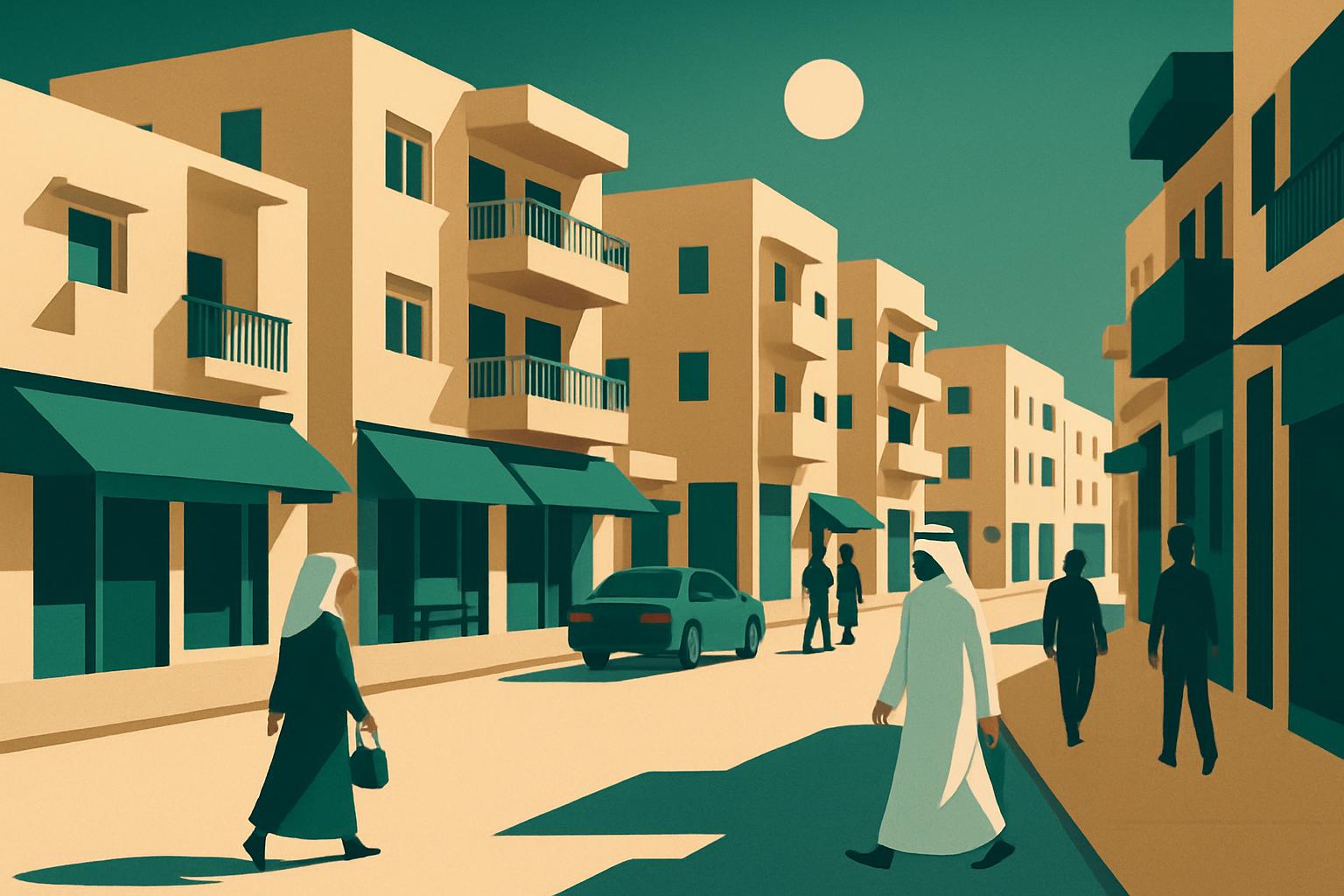
Hot-climate and car-first cities: Nature and Anthropos decide
Dubai, Doha, Riyadh, Phoenix, much of Texas, and — for four months a year — Athens, Seville and Rome. Transit maps and café counts mislead here, because for a large part of the year the deciding question is whether the walk from your building to anything at all is bearable.
Tree canopy, building shadow, block length, the presence of a shaded arcade: these look like landscaping and behave like infrastructure. A neighbourhood with high greenery and short blocks stays usable in August. A neighbourhood with wide roads, no canopy and 400-metre blocks does not, and the fallback is a car for every trip, which reshapes your budget and your day.
What to check: satellite greenery in your immediate radius rather than city-wide averages, and whether daily errands are reachable on foot in the worst month rather than the best one.
Cities you are moving to alone: Society decides
If you are arriving without a ready-made network — a new job in a new country, a remote worker landing somewhere with no colleagues — the pillar that decides your first year is the one that is hardest to measure and easiest to dismiss. Not nightlife. The unglamorous social infrastructure: markets, libraries, sports clubs, playgrounds, places of worship, a gym with the same faces in it, cafés where people linger instead of collecting a cup and leaving.
A beautifully connected, superbly built neighbourhood of commuters can still be a lonely place to land. Society scores are the closest proxy for whether the street has a life you can join rather than only observe.
The short version: Pick the pillar whose failure you cannot walk away from. You can walk ten minutes to a better park; you cannot walk out of a cold flat, a two-hour commute or a street that empties at six.

Finding your deciding pillar in a week
You do not need a spreadsheet with forty rows. You need three honest answers and a couple of hours.
- Name what breaks your day. Not what you admire — what actually ruins a Tuesday for you. Commuting. Cold. Noise. Not knowing anyone. That is your candidate pillar.
- Ask what this city makes scarce. Read two or three neighbourhoods you are considering across all five scores and look for the pillar with the widest spread. Where the city is uniformly good, the choice does not matter. Where scores swing from 4 to 9, that is where your decision lives.
- Check the worst case, not the average. The rainiest evening, the hottest afternoon, the emptiest Sunday. Neighbourhoods are chosen on their best day and lived in on their worst.
Then, and only then, compare rents. A place that fails your deciding pillar is not cheaper. It is a discount on something you will spend the year paying for anyway.
Where HoodEx fits
This is exactly the comparison HoodEx is built to make quick: any address, scored 0–10 across all five pillars from satellite imagery, street-level imagery, points of interest and public data, so you can see the shape of a neighbourhood rather than a single number. Look at two or three candidates side by side and the deciding pillar usually announces itself — it is the row where the numbers refuse to agree.
Browse what has already been analysed by city, or run the address you are seriously considering and read the five rows before you read the total.
Related posts
- How to evaluate safety and walkability before moving
- Why real-time sentiment beats static neighborhood data
- Walk Score vs AreaVibes vs Hoodex: what neighborhood scores measure (and miss)
More from the HoodEx blog · City studies · Explore neighborhoods